experiment log template: How to Structure Lab Experiment Records
An experiment log template is a structured document that helps researchers consistently record the purpose, materials, methods, observations, and outcomes of laboratory experiments. For molecular biology and biotech teams, a well-designed experiment log template is more than a formatting exercise — it is the foundation for reproducible research, reliable data traceability, and effective collaboration across projects.
Whether a lab is running PCR amplifications, plasmid constructions, CRISPR gene editing experiments, or protein purifications, the quality of experiment documentation often determines whether results can be interpreted weeks, months, or years later. This article explains what an experiment log template should include, why format and consistency matter, and how to evaluate whether a paper log, spreadsheet, or connected electronic lab notebook (ELN) is the right fit for your team's workflow.
What Is an Experiment Log Template?
An experiment log template is a predefined format that researchers use to record key details about each experiment before, during, and after the bench work. It typically includes fields for experiment title, date, objectives, materials and reagents, protocol steps, observations, raw data references, results summary, and next steps.
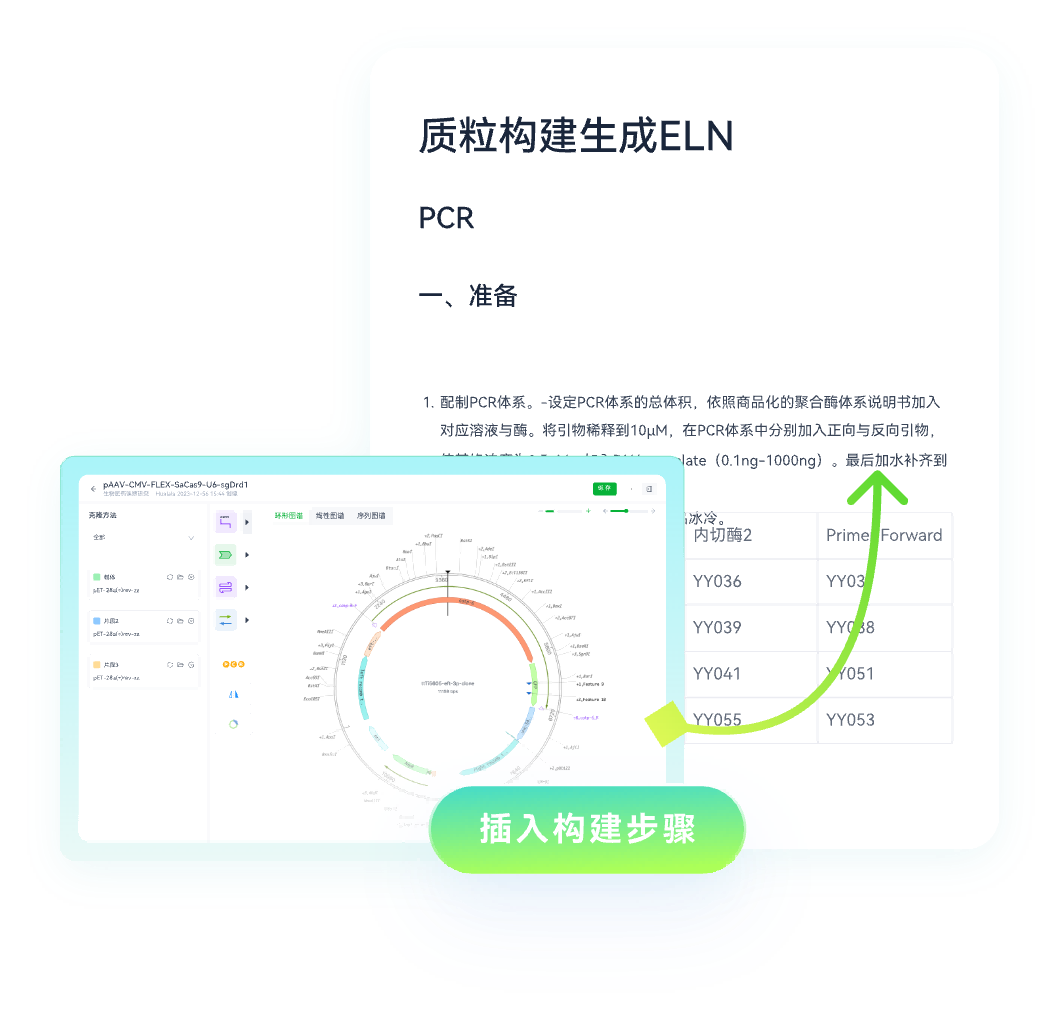
In molecular biology, experiment logs often need to capture additional context that generic templates do not cover: sequence file references, plasmid map identifiers, primer sequences, enzyme lot numbers, gel electrophoresis images, and alignment results. A template designed for molecular biology experiments should account for these data types, not force researchers to shoehorn structured scientific work into a generic form.
The distinction matters because experiment logs serve multiple audiences. A researcher may revisit a log to reproduce a protocol. A principal investigator may review logs to assess project progress. A lab manager may audit logs for documentation completeness. A regulatory or quality team may examine logs for traceability during an audit or technology transfer. Each of these use cases requires a template that captures enough structured information to be useful without becoming so rigid that researchers avoid filling it in.
Why a Consistent Experiment Log Format Matters for Research Teams
Inconsistent experiment documentation is one of the most common sources of wasted time in research labs. When each team member records experiments in a different format — or worse, relies on memory and loose notes — critical details get lost. A primer sequence that was not recorded, a reagent lot number that was skipped, or a protocol deviation that was not noted can make the difference between a reproducible result and a dead end.
For molecular biology teams, the consequences extend beyond individual experiments. Plasmid construction projects often involve multiple rounds of cloning, verification, and redesign. If the experiment log for the first cloning attempt does not clearly reference the sequence files, restriction sites, and ligation conditions used, the next attempt will require the researcher to reconstruct the design from scratch. Similarly, CRISPR experiments depend on precise records of guide RNA sequences, target sites, transfection conditions, and downstream validation results. Without a structured log, these details become fragmented across notebooks, file folders, and chat messages.
A consistent experiment log template also supports research continuity. When a graduate student graduates, a postdoc moves on, or a biotech startup scales its team, experiment logs are often the only record that preserves institutional knowledge. Teams that invest in a standardized template and documentation workflow reduce the risk of losing critical experimental context during personnel transitions.
Key Fields to Include in an Experiment Log Template
The specific fields in an experiment log template should reflect the type of experiments a lab runs, but several core elements are broadly applicable across molecular biology and biotech research.
Experiment identification. Every log entry needs a clear title, a unique identifier or project reference, the date, and the name of the researcher. This seems basic, but in high-throughput labs, experiments run in parallel can easily get mixed up without consistent identification.
Objective and hypothesis. A brief statement of what the experiment aims to test or accomplish. This provides context for future readers and helps distinguish between exploratory experiments and confirmatory ones.
Materials and reagents. A list of all reagents, enzymes, buffers, cell lines, and consumables used, including catalog numbers, lot numbers, and concentrations where relevant. For molecular biology experiments, this section should also include sequence references such as plasmid IDs, primer sequences, and guide RNA sequences.
Protocol and methods. The step-by-step procedure followed, including any deviations from the standard protocol. A good template allows researchers to reference an existing standard operating procedure (SOP) while noting modifications, rather than rewriting the entire protocol each time.
Observations and raw data. Space for recording real-time observations — gel images, spectrophotometer readings, cell morphology notes, temperature logs, and any unexpected events during the experiment. The template should support references to raw data files rather than requiring all data to be pasted into the log itself.
Results and analysis. A summary of the key findings, including whether the experiment met its objective. This section should distinguish between raw observations and interpreted results.
Next steps and cross-references. Notes on what the experiment suggests for future work, and links to related experiments, project files, or sequence data. This section is where experiment logs transition from individual records to connected research documentation.
Review and approval. For teams that require documentation review, a field for supervisor sign-off or peer review adds an additional layer of traceability.
How Different Lab Documentation Approaches Compare
Research teams typically use one of three approaches to experiment logging, each with different trade-offs.
Paper lab notebooks. Paper notebooks are familiar and require no setup, but they are difficult to search, impossible to back up automatically, and cannot be simultaneously accessed by multiple team members. For molecular biology experiments that generate digital data — sequence files, gel images, alignment results — paper logs create a gap between the experiment record and the underlying data.
| Dimension | Paper Notebook | Spreadsheet / Document | Connected ELN Template |
|---|---|---|---|
| Searchability | Manual page-by-page | Keyword search within file | Full-text search across all records |
| Data linkage | Handwritten file references | Hyperlinks (may break) | Direct cross-references to files, sequences, and projects |
| Team access | One person at a time | Shared drive, version conflicts | Simultaneous access with permission control |
| Template consistency | Depends on individual discipline | Template can be copied | Enforced template structure across the team |
| Audit trail | None | Limited | Timestamped entries with version history |
| File attachment | Physical printouts only | Embedded or linked files | Integrated file storage with context |
| Sequence data context | Not supported | Not supported | Link to plasmid maps, primers, alignments |
| Scalability | Low | Medium | High |
Spreadsheets and generic documents. Spreadsheets (Excel, Google Sheets) and document editors (Word, Google Docs) offer more structure than paper and are easy to share, but they have their own limitations. Template consistency depends on researchers copying the file correctly. File references can break. Version control is manual. And most importantly, spreadsheets and documents treat experiment records as isolated files rather than connected parts of a research project.
Connected ELN experiment log templates. An ELN with purpose-built experiment log templates addresses many of the gaps left by paper and spreadsheets. Experiment records can be linked to project files, sequence data, team members, and previous experiments. Templates enforce consistent structure while allowing researchers to adapt fields to specific experiment types. Permissions control who can view, edit, or approve records. And because ELN records are stored in the cloud, they remain accessible as teams grow, move, or transition.
For molecular biology teams, the advantage of a connected ELN template becomes clearest when experiment records need to reference sequence data. An experiment log entry for a cloning experiment is significantly more useful when it links directly to the plasmid map, primer sequences, and alignment results that were part of the experiment — rather than requiring a separate search through file folders or email threads.
Experiment Log Template Scenarios in Molecular Biology
Different experiment types call for different levels of detail in the log template. Here are three common molecular biology scenarios where a structured experiment log makes a practical difference.
Scenario 1: Plasmid Construction and Cloning
A researcher is building an expression vector by inserting a gene of interest into a mammalian expression plasmid. The experiment involves restriction digestion, ligation, transformation, colony PCR screening, and sequence verification. A well-structured experiment log for this workflow should capture the source plasmid and destination vector identifiers, restriction enzymes and buffer conditions, insert-to-vector ratios, transformation strain and conditions, screening primer sequences, and sequencing results with alignment to the expected construct.
When the experiment log captures this level of detail, a failed construct can be debugged by reviewing the log rather than repeating the entire workflow. And when the construct succeeds, the log becomes a reliable reference for the next cloning project that uses the same vector backbone or cloning strategy.
Scenario 2: CRISPR Gene Editing Experiment
A team is performing a CRISPR-Cas9 knockout experiment. The experiment log needs to record the target gene, guide RNA sequence and design rationale, Cas9 variant used, delivery method, cell line and passage number, transfection conditions, and validation approach — typically Sanger sequencing, T7E1 assay, or Western blot.
CRISPR experiments generate decisions at multiple stages: guide RNA selection, experimental execution, and result validation. If the experiment log template only captures the bench protocol but not the design rationale, future team members will not understand why a particular guide was chosen or what off-target considerations were evaluated. A template that includes fields for design context, not just protocol steps, produces more useful records.
Scenario 3: PCR Optimization
A lab is optimizing PCR conditions for a difficult template. Multiple rounds of optimization vary annealing temperature, MgCl₂ concentration, and polymerase choice. Each round generates gel images and notes on band specificity and yield. An experiment log that tracks the progression across rounds — with references to the specific conditions tested in each — allows the team to converge on optimal conditions rather than re-testing combinations that were already tried.
What to Evaluate When Choosing an Experiment Log Solution
Selecting the right approach to experiment logging depends on several practical factors that go beyond template format alone.
Workflow fit. Does the template accommodate the types of experiments your lab runs? A template designed for chemistry experiments may not capture the sequence references and molecular cloning details that a biology lab needs. Evaluate whether the template can be adapted without becoming overly complex.
Consistency and enforcement. A template is only useful if the team actually uses it consistently. Paper templates depend on individual discipline. Spreadsheet templates can be modified or ignored. ELN templates with enforced fields and team-level defaults tend to produce more consistent records.
Data connectivity. Can the experiment log reference the data it relates to? For molecular biology teams, this means linking to sequence files, plasmid maps, gel images, alignment results, and project folders. A log entry that exists in isolation from its supporting data loses much of its long-term value.
Search and retrieval. When a team member needs to find the experiment log from a specific cloning attempt six months ago, how quickly can they locate it? Full-text search, project-based organization, and tagging all improve retrieval speed compared to scrolling through a physical notebook or a folder of spreadsheets.
Collaboration and permissions. Can multiple team members access relevant experiment logs? Can a PI review and annotate entries? Can a new team member read the experiment history for a project they are joining? These collaboration requirements are difficult to meet with paper logs or personal spreadsheets.
Traceability and audit readiness. For teams working in regulated environments or preparing for technology transfer, experiment logs need to provide a clear, timestamped, and tamper-evident record. Evaluate whether the documentation approach supports version history, access logs, and review workflows.
Training and adoption burden. Even the best template will fail if the team finds it burdensome to complete. Evaluate how much time researchers spend filling in the template, whether the template reduces redundant documentation, and whether new team members can learn the format quickly.
How Zettalab Supports Structured Experiment Logging
For molecular biology and biotech teams that want to move beyond paper notebooks or disconnected spreadsheets, Zettalab offers a connected workspace where experiment log templates live alongside the sequence tools, project files, and collaboration features that researchers already use.
ZettaNote provides structured experiment documentation with templates, annotations, cross-references, and permission-aware collaboration. Rather than treating experiment logs as standalone documents, ZettaNote connects them to the broader project context — including files, sequence data, and team members. Templates can be standardized at the team level so that every researcher records experiments in a consistent format, while still allowing flexibility for different experiment types. For teams that need traceability, ZettaNote supports timestamped entries and review workflows that make experiment records audit-ready.
ZettaGene complements experiment logging by providing molecular biology tools for sequence visualization, plasmid construction, primer design, and alignment. When a researcher designs a primer or builds a construct in ZettaGene, the output can be referenced directly in a ZettaNote experiment log, closing the gap between design and documentation. This connection is particularly relevant for cloning, CRISPR, and PCR workflows where the experiment record depends on specific sequence-level details.
ZettaFile supports the file management layer that experiment logs depend on. Raw data files, gel images, sequencing results, and protocol documents can be organized by project with permission controls, so experiment log entries can reference files that are stored centrally rather than scattered across individual computers or cloud drives.
Together, these tools help teams build an experiment documentation workflow where the log template is not a standalone form, but part of a connected R&D environment that includes sequence design, file storage, and team collaboration.
Implementation Considerations for Adopting an Experiment Log Template
Moving a team to a standardized experiment log template — whether on paper or in an ELN — requires attention to practical implementation details.
Start with the most common experiment types. Rather than trying to design one universal template that covers every possible experiment, start by building templates for the two or three experiment types your lab runs most frequently. Refine these based on researcher feedback before expanding to less common workflows.
Balance structure with flexibility. A template with too many mandatory fields will discourage researchers from completing it thoroughly. A template with too few fields will not capture enough information to be useful later. The right balance depends on the team's experiment types, regulatory requirements, and documentation culture.
Define what "complete" looks like. Establish clear expectations for what a finished experiment log entry should include. For some teams, this means every field must be filled. For others, it means certain critical fields — such as materials, protocol deviations, and results — are mandatory while others are optional.
Plan for legacy data. Most teams have existing experiment records in notebooks, spreadsheets, or personal files. Decide whether these records need to be migrated to the new system, and if so, how to prioritize which records to bring over.
Train the team on the "why," not just the "how." Researchers are more likely to adopt a new documentation workflow when they understand how consistent experiment logs benefit their own work — faster troubleshooting, easier project handoffs, and more reliable references for publications and reports.
Review and iterate. After the first few weeks of using a new template, gather feedback from the team. Are there fields that researchers consistently skip? Are there common experiment details that the template does not capture? Use this feedback to refine the template rather than enforcing a format that does not fit the actual workflow.
FAQ
What is an experiment log template? An experiment log template is a structured format that researchers use to consistently record the details of laboratory experiments, including objectives, materials, methods, observations, results, and next steps. In molecular biology, a good template also captures sequence references, plasmid identifiers, primer sequences, and other data specific to the experiment type. The goal is to create a record that is detailed enough for future reproduction, review, and collaboration.
Why is a consistent experiment log format important? A consistent format ensures that critical details are not missed, experiment records can be searched and retrieved efficiently, and team members can understand each other's work. Inconsistent logging leads to lost protocol details, unreproducible results, and time spent reconstructing experiments from incomplete notes. For teams in biotech and regulated environments, consistency also supports traceability and audit readiness.
What fields should a molecular biology experiment log template include? At minimum, a molecular biology experiment log should include experiment title, date, researcher name, project reference, objective, materials and reagents with lot numbers, protocol steps with any deviations, observations and raw data references, results summary, next steps, and cross-references to related experiments or sequence data. Depending on the experiment type, additional fields for plasmid maps, primer sequences, guide RNA designs, or alignment results may be needed.
How is an ELN experiment log template different from a spreadsheet template? A spreadsheet template is a standalone file that researchers copy and fill in manually. It offers limited searchability, no built-in version history, and no direct connection to project files or sequence data. An ELN experiment log template enforces consistent structure, supports full-text search across all records, links experiment entries to files and sequence tools, and provides permission controls for team access. For molecular biology teams, the ability to connect experiment logs with plasmid maps, primer designs, and alignment results is a key advantage of ELN-based templates.
Can I use one experiment log template for all experiment types? A single universal template often becomes either too generic to capture experiment-specific details or too complex for everyday use. A more practical approach is to create a core template with common fields and then add experiment-specific sections for the most common experiment types your lab runs — such as cloning, PCR, CRISPR editing, or protein expression. Many ELN systems support multiple templates within the same workspace.
How does Zettalab help with experiment log documentation? Zettalab connects experiment documentation with the molecular biology tools and file storage that researchers already use. ZettaNote provides structured experiment log templates with cross-references, annotations, and team-level consistency. ZettaGene supports sequence design, plasmid construction, and primer design, with outputs that can be referenced directly in experiment logs. ZettaFile organizes project files with permission controls, so experiment records can link to the underlying data rather than existing in isolation.
What should a lab consider before switching from paper notebooks to a digital experiment log? Key considerations include whether the digital format accommodates the lab's experiment types, how existing paper records will be handled, whether the team can access and search records efficiently, how file attachments and sequence data are managed, what training is needed for adoption, and whether the system supports the team's collaboration and traceability requirements. It is usually most effective to start with the most common experiment types and expand gradually based on team feedback.
Conclusion
An experiment log template is most valuable when it reflects the real workflow of the researchers who use it. For molecular biology and biotech teams, this means capturing not only the standard fields — objectives, materials, methods, results — but also the sequence references, design rationale, and file cross-references that make experiment records truly reproducible and reviewable.
The choice between paper, spreadsheets, and a connected ELN depends on the team's size, experiment complexity, collaboration needs, and traceability requirements. For teams that need experiment logs to function as part of a larger research workflow — connected to sequence data, project files, and team collaboration — a platform like Zettalab offers a practical path forward.
If your team is evaluating experiment documentation tools, consider starting with ZettaNote experiment log templates and exploring how connected molecular biology tools can reduce the gap between experiment design, execution, and documentation. Start a free trial or explore Zettalab's molecular biology workspace to see how structured experiment logging fits your workflow.
相关文章